Read experiment results
Interpret descriptive totals, analysis status, variant effects, and traffic checks.
Open an experiment's Results page after mapping and syncing it with a supported testing provider. Results show the baseline, last sync time, visitor and conversion totals, overall conversion rate, Sample Ratio Mismatch, and variant effects.
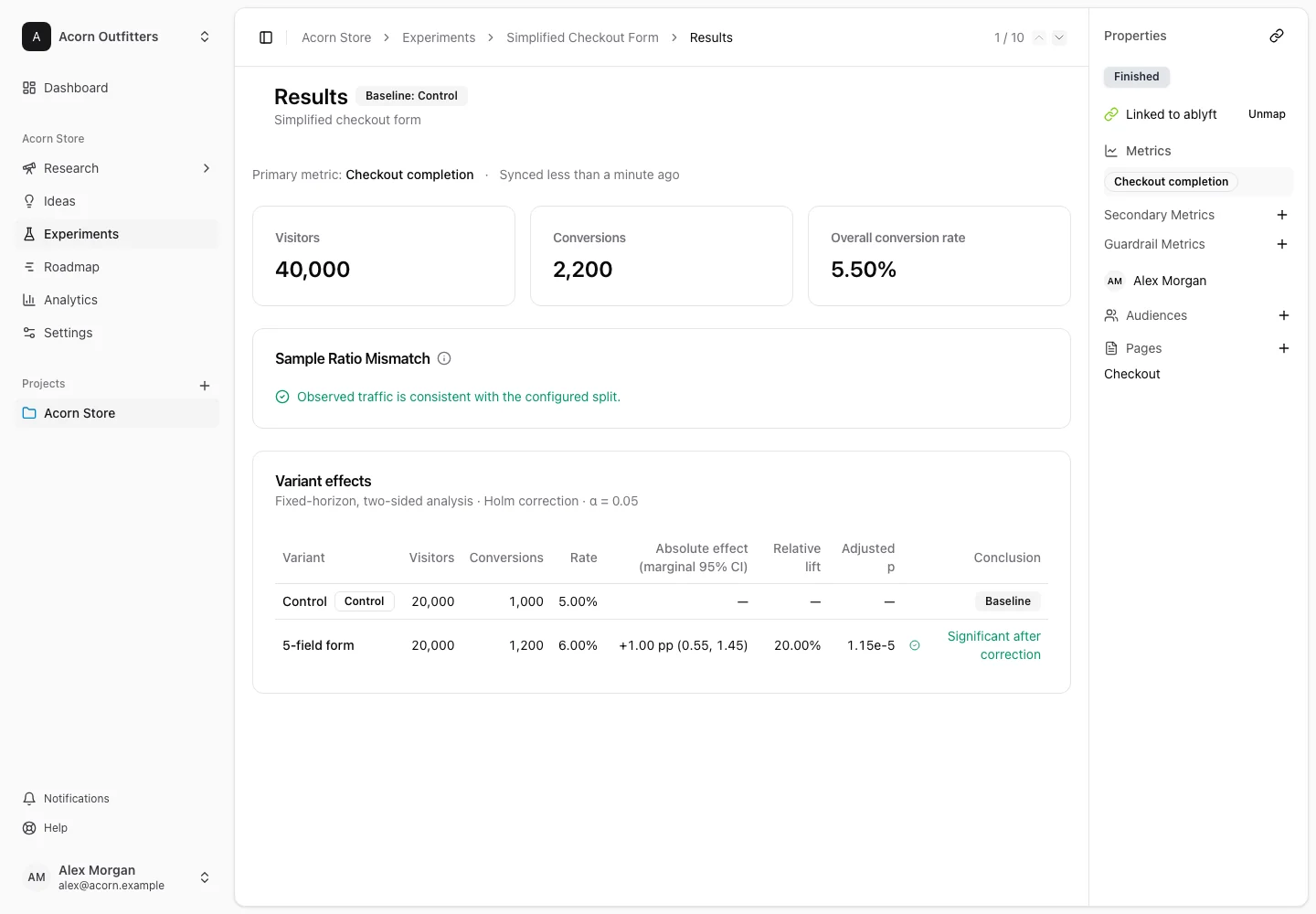
Check readiness before the conclusion
- Verify the correct experiment, baseline, and primary metric.
- Check the last sync time and any status banner.
- Review visitor and conversion totals for the expected variations.
- Inspect Sample Ratio Mismatch before using statistical conclusions.
- Read the effect estimate, uncertainty, and corrected significance together.
The current statistical report uses fixed-horizon, two-sided analysis with Holm correction for the reported comparisons. It supports rate-per-user primary metrics. The planned end date must have passed and the result status must be stopped before inference is ready. Interim totals can still be descriptive.
Understand report states
| Status message | What to do |
|---|---|
| No synced result data | Map and sync the experiment. |
| Result mapping is incomplete | Map the primary metric and every provider variation one-to-one. |
| Primary metric is not supported yet | Check the metric type; fixed-horizon v1 supports rate-per-user metrics. |
| Fixed-horizon analysis is not ready | Check the planned end date and stopped result status. |
| Not enough data for a trustworthy conclusion | Keep the result descriptive until the analysis checks pass. |
| Traffic allocation mismatch detected | Investigate expected versus observed allocation before using significance. |
| Result data is stale | Sync again and inspect the refreshed status. |
| Experiment configuration cannot be analyzed | Check baseline, allocation, source, and observed counts. |
| Statistical analysis is temporarily unavailable | Keep descriptive totals available and retry after recovery. |
Interpret variant effects
A label of Significant after correction means the comparison passed the report's corrected significance check. Not significant after correction does not establish that the variations are equivalent. When a readiness or traffic check blocks inference, use the status explanation instead of reading a displayed descriptive uplift as a decision.
Record the team's decision separately on the experiment, and document the context in a learning. See result troubleshooting for a recovery checklist.